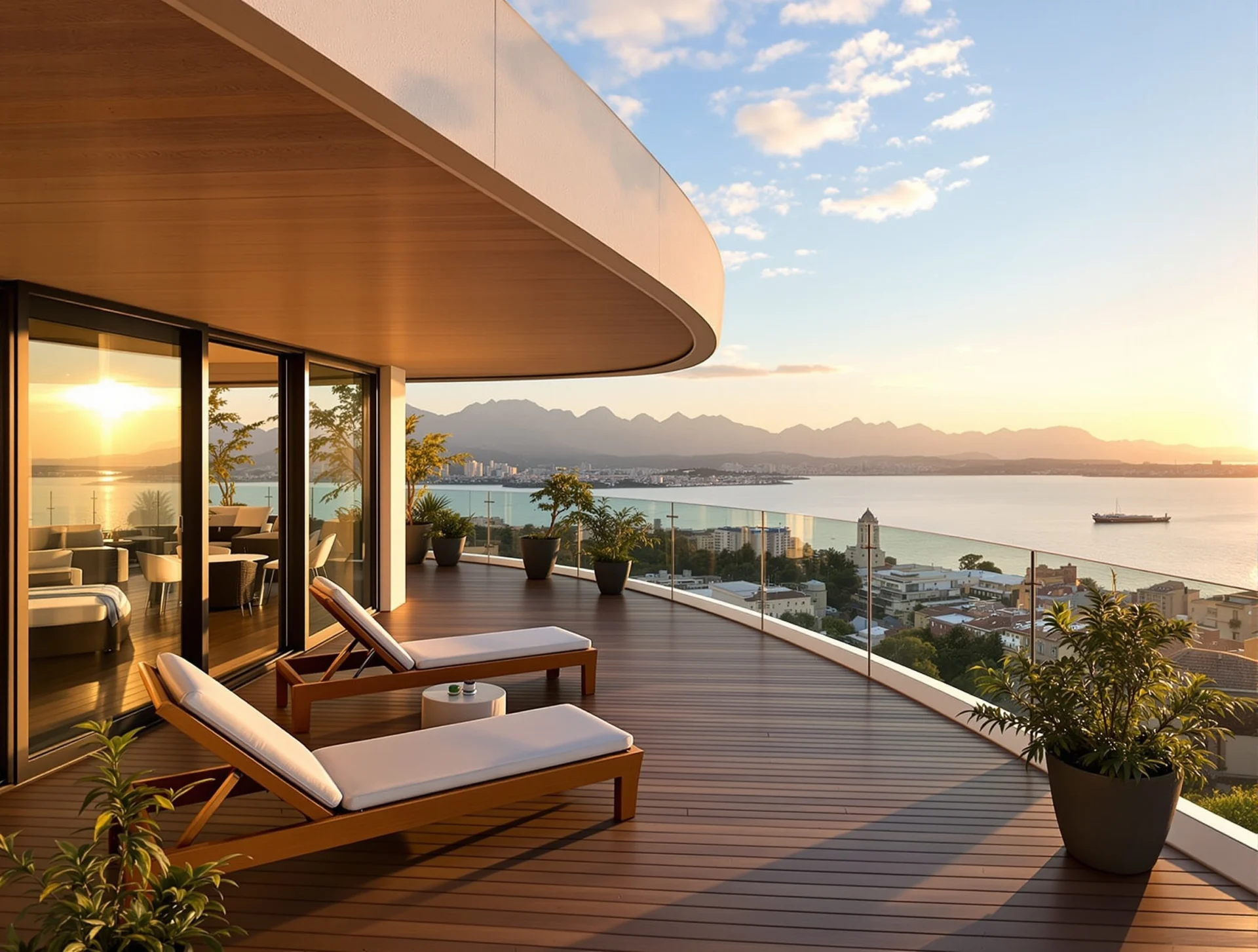
If you are planning a wooden terrace, deck, or pool surround in Mallorca, suppliers will almost certainly offer two main timber options: IPE (Brazilian ironwood) and treated pine (typically AITIM-certified red pine). Both perform well in the Mediterranean climate. Neither is objectively “better” in every situation. The right choice depends on your budget, target lifespan, maintenance appetite, and aesthetic goals.
This guide compares both materials directly, criterion by criterion. It helps you prepare for quote conversations with contractors so you know what questions to ask.
Short answer: IPE is a dense tropical hardwood. It can last 50+ years with minimal upkeep and offers a rich dark-brown finish at a higher upfront cost. Treated pine is a pressure-treated European softwood certified for outdoor use. It typically lasts 15–25 years, costs less per square metre, and needs more frequent re-oiling. Below, we break down exactly why.
This is a decision guide written for a specific climate. Mallorca combines intense summer UV, long dry spells, sudden autumn downpours, and near-constant coastal salt aerosol. These four conditions stress decking timber more than typical inland climates. Therefore, material selection matters significantly here.
Why Wood Species Matters More in Mallorca Than Elsewhere
Before comparing IPE and treated pine, you should understand how the Mediterranean island climate stresses decking timber.
- UV intensity. Mallorca receives significantly more direct annual sunlight hours than most of central and northern Europe. UV exposure drives surface greying and breaks down protective oils. Consequently, a deck here weathers faster than the same board in a cooler climate. Natural timber density or preservative treatment must compensate for this.
- Salt aerosol. Properties within a few kilometres of the coast face airborne salt particles daily. Salt accelerates coating breakdown and corrodes metal fixings faster than inland environments do.
- Dry-to-wet cycling. Mallorca’s climate alternates between long, hot dry spells and sudden, heavy downpours. This cycling forces wood to dry out for weeks and then absorb sudden moisture. The resulting expansion and contraction stress the wood heavily.
- Pool and reflected heat exposure. For pool decks, water surfaces reflect light and heat. This creates a secondary UV source that accelerates surface wear.
Wood remains a proven, popular choice for Mallorca outdoor spaces. However, the local climate leaves a smaller margin for error, making timber species and certifications critical.
What Is IPE Decking?
Harvesters source IPE (pronounced “ee-pay”) from South America, primarily Brazil, Paraguay, and Bolivia. The timber comes from trees in the Handroanthus genus (formerly Tabebuia). Suppliers in international property markets also sell it as Brazilian ironwood or Brazilian walnut.
Structural Properties of IPE
IPE provides three major structural advantages in outdoor construction:
- Density. IPE is one of the densest commercial decking timbers available. Its Janka hardness rating is three to four times higher than softwoods. This density provides natural resistance to rot, fungal decay, and insects without chemical treatment.
- Natural oil content. The wood contains natural oils that repel water. These oils slow moisture absorption in harsh coastal environments.
- Dimensional stability. Because of its extreme density, IPE expands and contracts minimally during humidity swings. This stability protects pool decks and sun-exposed terraces.
With proper installation and light maintenance, IPE regularly achieves a 50-year service life.
IPE: Advantages and Limitations
Advantages:
- Delivers exceptional natural resistance to rot, insects, and decay without chemical treatments.
- Provides a realistic service life of 50 years or more.
- Resists Mallorca’s UV and salt aerosol better than almost any other timber.
- Maintains high structural stability with minimal warping, cupping, or gapping.
- Ages gracefully; many owners appreciate the natural silver patina.
- Adds high perceived value to luxury villas and long-term investments.
Limitations:
- Demands a higher upfront material budget than treated pine.
- Adds significant weight, requiring stronger substructures on raised decks.
- Blunts tools quickly and takes longer to cut and drill on-site.
- Features a naturally dark tone, requiring regular oiling if you prefer a warm, light look.
- Requires lead-time confirmation due to variable FSC-certified stock availability.
What Is Treated Pine (AITIM) Decking?
Suppliers in Mallorca typically use European red pine (Pinus sylvestris). Manufacturers place the timber in vacuum pressure chambers to force preservative chemicals deep into the wood fibres. This treatment protects the softwood against rot, decay, and insect damage.
AITIM is the Spanish technical association for timber and cork (Asociación de Investigación Técnica de las Industrias de la Madera y el Corcho). AITIM certification verifies that the pine has passed rigorous testing for specific outdoor durability classes. Treated pine typically lasts 15 to 25 years when properly installed, drained, and oiled.
Treated Pine: Advantages and Limitations
Advantages:
- Lowers upfront installation costs significantly per square metre.
- Reduces load weight on balconies, rooftops, and raised platforms.
- Allows faster on-site cutting and fixing.
- Offers a warm, honey tone that complements light coastal aesthetics.
- Carries documented quality standards through AITIM certification.
- Suits budget-conscious projects, secondary areas, or short-term property horizons.
Limitations:
- Offers a shorter lifespan (15–25 years) than IPE.
- Requires strict, regular maintenance to prevent deterioration.
- Develops surface checking (fine cracks) faster under intense UV if neglected.
- Requires predictable annual re-oiling to retain protective barriers.
Sourcing and Certification
Not all IPE on the market comes from sustainable sources. You should look for FSC (Forest Stewardship Council) certification. This confirms responsible forest management and full chain-of-custody documentation. Always ask your contractor to confirm FSC certification in writing before signing a contract.
Clarifying Decking Terminology
Decking terms can easily confuse buyers during quote comparisons:
- Name variations: IPE, Brazilian ironwood, and Brazilian walnut refer to the same wood group. Always verify the botanical species and certification.
- Tropical hardwood broadness: “Tropical hardwood” is an umbrella category, not a specific timber. Woods like Cumaru or Garapa differ from true IPE in density, cost, and lifespan.
- Treatment standards: Generic “treated pine” does not guarantee AITIM certification. Always verify official certification for your specific batch.
- Grading differences: Timber comes in multiple grades based on knot frequency and straightness. Ensure quotes specify the exact grade.
Direct Comparison: IPE vs Treated Pine
| Criterion | IPE (Brazilian Ironwood) | Treated Pine (AITIM) |
| Typical Lifespan | 50+ years | 15–25 years |
| Density / Hardness | Very high (natural rot resistance) | Moderate (relies on chemical treatment) |
| Upfront Cost / m² | Higher | Lower |
| Maintenance Needs | Low (oiling optional for colour) | Higher (annual oiling recommended) |
| Natural Colour | Dark brown (silvers if unoiled) | Warm honey (greys if untreated) |
| Weight | Heavy (affects structural design) | Light (ideal for load-sensitive decks) |
| Salt Air Resistance | Excellent (inherent natural oils) | Good (depends on maintained sealants) |
| Certification | FSC (Forest Stewardship Council) | AITIM |
| Best Application | Long-term villas, pool surrounds | Budget projects, rooftops, secondary decks |
Understanding the Cost Drivers
Material and supply chain factors drive the price difference between these two timbers:
- Import logistics: Shippers transport IPE from South America. In contrast, European forestry supplies regional pine, keeping transport costs low.
- Milling complexity: Pressure-treating pine is a rapid industrial process. Processing dense IPE blunts machinery and demands more labour.
- Growth rates: IPE trees mature slowly in natural forests. Pine grows quickly in managed commercial plantations.
- Amortised value: IPE costs more initially. However, its 50-year lifespan delivers comparable yearly costs because pine requires earlier replacement.
Always treat advertised per-square-metre prices as estimates. Site slope, access, existing surfaces, and drainage dictate the final cost.
Maintenance Requirements
Neither wood is completely maintenance-free. However, the maintenance schedules and the consequences of neglect differ.
IPE Care Rhythm
- IPE retains its structural strength without oiling.
- Sun exposure turns unoiled IPE into a silver-grey patina over 12–24 months.
- Applying UV-protective oil every 12–18 months preserves the deep brown colour.
- Periodic light sweeping and washing keep drainage channels clear.
Treated Pine Care Rhythm
- Pine relies heavily on topical sealants and annual oiling to survive high-UV island conditions.
- Neglecting pine accelerates surface checking and moisture absorption.
- Adequate airflow beneath the substructure prevents softwood rot.
Key Installation Factors
Installation quality dictates the ultimate performance of your deck.
- Hidden fixing systems: Hidden fixings eliminate visible screw penetrations on board faces. This reduces water pooling and gives a sleek finish.
- Substructure and airflow: Joist spacing, ventilation, and adequate slopes prevent water traps beneath the boards.
- Acclimatisation: Installers must let timber acclimatise on-site for several days to adapt to local humidity.
- Ground preparation: Laying decks over grass or soil requires deeper groundwork than installing over flat concrete.
Practical Scenarios
Scenario 1: South-Facing Coastal Villa Pool Deck
This environment combines direct sun, water reflection, salt spray, and heavy foot traffic. IPE’s extreme density easily justifies its higher price. It avoids the early replacement cycles that softer timbers face under maximum stress.
Scenario 2: Old Town Palma Rooftop Terrace
Rooftops have strict weight limits. Treated pine reduces the overall load on historic buildings. Adding a pergola extends pine’s lifespan by reducing direct UV rays.
Scenario 3: Holiday Home Used Seasonally
Owners who visit for only a few weeks each year often prefer lower initial investments. Treated pine offers a practical, attractive solution for low-traffic garden terraces.
Scenario 4: Properties Targeted for Resale within 3–5 Years
Sellers often select materials based on immediate visual appeal and manageable startup costs. Treated pine delivers an attractive look without long-term capital commitments.
A Four-Step Decision Framework
Answer these four questions to determine the right material for your property:
- What is your ownership horizon? Long-term homeowners gain higher amortised value from IPE’s 50-year lifespan.
- How intense is the exposure? Coastal, unsheltered pool decks demand IPE. Partially shaded areas handle treated pine well.
- What are the structural weight limits? Balconies and rooftop decks often require lighter pine boards.
- How much maintenance will you perform? Choose IPE for a set-and-forget deck. Choose pine if you plan to oil the wood yearly.
Mixing Materials Across One Property
Many Mallorca projects combine both timbers effectively. You can install IPE across high-traffic pool surrounds and use treated pine for side walkways or shaded garden terraces. This approach directs your budget where durability matters most.
Annual Maintenance Calendar
Yearly Rhythm for IPE
- Spring: Sweep debris and rinse boards to ensure open drainage gaps.
- Early summer (optional): Apply UV deck oil to preserve the brown colour before peak summer sun.
- Autumn: Clear fallen leaves to prevent moisture accumulation.
- Winter: Ensure storm run-off drains freely; no winter treatments needed.
Yearly Rhythm for Treated Pine
- Spring: Inspect boards for surface checks and clear winter dirt.
- Early summer: Apply protective decking oil across all boards.
- Autumn: Inspect joints and fixings for seasonal moisture ingress.
- Winter: Remove standing water promptly after heavy rainstorms.
Environmental and Sustainability Considerations
Environmental priorities vary by project:
- Carbon footprint: European pine travels shorter distances than South American hardwoods.
- Resource cycles: Pine grows rapidly on managed timber plantations.
- Lifecycle durability: One IPE deck outlasts two or three pine installations, reducing total manufacturing cycles.
- Certified sourcing: Request FSC chain-of-custody documentation for IPE and verified forestry certifications for pine.
Checklist for Requesting Quotes
- Demand written timber species names along with FSC or AITIM certification numbers.
- Confirm that quotes detail all substructure joists, drainage provisions, and ventilation plans.
- Specify your preferred fixing method (hidden clips vs. face screws).
- Request on-site moisture acclimatisation in the project timeline.
- Ask contractors to state their recommended oiling schedule and chemical products in writing.
- Require an on-site inspection before accepting any binding estimate.
Common Mistakes to Avoid
- Skipping written certifications: Never accept verbal assurances for FSC or AITIM ratings.
- Evaluating quotes on surface price alone: Cheap quotes often exclude essential groundwork, ventilation, or durable substructures.
- Overlooking fixing grades: Marine environments quickly corrode low-grade screws. Specify A2 or A4 stainless steel fixings.
- Ignoring gap calculations: Decks require precise expansion gaps between boards to prevent buckling during rain.
- Ordering without on-site assessments: Remote quotes cannot account for ground slopes, soil stability, or wind exposure.
About FIJI Patio Design
FIJI Patio Design constructs bespoke wooden terraces, decks, and pergolas from its base in Andratx, serving clients across Mallorca.
- Holds a 5.0 Google rating from clients across Palma, Port d’Andratx, Santa Ponsa, Sóller, and Bendinat.
- Builds with FSC-certified IPE, AITIM-certified treated pine, and Qualicoat-certified aluminium.
- Focuses on specialised timber engineering and outdoor structures.
- Delivers detailed quotes within 5 working days following on-site surveys, completing most installations in 1 to 3 weeks.
- Provides a Lifetime Aftercare programme with scheduled inspections and maintenance support.
FIJI Patio Design offers free, no-obligation site visits to assess properties and compare material options directly.
Frequently Asked Questions
Is IPE the same as Brazilian ironwood?
Yes. IPE is the Brazilian Portuguese name, while English-speaking markets commonly use Brazilian ironwood or Brazilian walnut for this species group.
How much does an IPE terrace cost compared to treated pine in Mallorca?
IPE costs more per square metre upfront due to shipping distances, hardness, and processing demands. Accurate pricing requires an on-site survey.
Does IPE need regular oiling?
No. IPE retains its structural durability without treatment. Oiling is purely a cosmetic choice to prevent the natural silver patina.
How long does treated pine decking last in Mallorca?
With AITIM certification and consistent annual maintenance, treated pine lasts 15 to 25 years in Mediterranean coastal climates.
Can you install treated pine around a pool?
Yes, provided you ensure excellent ventilation, anti-slip profiles, and regular sealing. However, IPE remains the more durable option for heavy-splash areas.
Can builders use IPE indoors and outdoors?
Yes. IPE works well for seamless indoor-outdoor transitions, provided installers accommodate indoor moisture barriers and acclimatisation.
Which certification should I demand on a quote?
Demand FSC certification for IPE and AITIM certification for treated pine. Ensure the contractor documents these in writing.
Which wood resists coastal salt air better?
IPE resists salt air naturally due to its high density and essential oils. Pine resists salt air well only if you maintain its protective finish consistently.
Does IPE or treated pine expand more during temperature swings?
Treated pine expands and contracts more. IPE remains dimensionally stable in direct Mediterranean sunlight.
Is repairing a treated pine deck cheaper than repairing IPE?
Replacing single pine boards costs less initially. However, pine requires more frequent repairs over its lifespan, raising total long-term maintenance costs.
Can I mix treated pine with an IPE extension later?
Yes. Experienced carpenters frequently connect existing pine sections to new IPE pool decks with clean transition joints.
Does pergola shade affect timber selection?
Yes. Pergola shade protects treated pine from direct UV degradation, helping it reach the upper limit of its 25-year lifespan.
Making the Final Decision
IPE rewards long-term investments with exceptional durability, high weather resistance, and minimal maintenance. Treated pine provides an affordable, lightweight alternative for budget-conscious or weight-sensitive projects.
Many Mallorca properties blend both materials across different zones to maximise performance and value. Book a comprehensive site visit to evaluate ground conditions, sun exposure, and load limits before choosing your timber.
Ready to Transform Your Outdoor Space?
Book a free consultation with Pedro or Stéphane. We will visit your property, bring wood samples, and deliver a transparent quote within five working days.


